Showing posts sorted by relevance for query February 1956. Sort by date Show all posts

Wednesday, 12 February 2020

Google Website Searches:
Focus On UFO News Articles From the Year 1956


Website: Newspapers.com (owned by Ancestry.com LLC, Lehi, Utah):

(Search term: “Flying Saucer” “1956”)

(“Flying Saucers” “1956”)

(“Flying Disc” “1956”) (no 1956 UFO articles as of 12 February 2020)

(“Flying Discs” “1956”)

(“Flying Disk” “1956”) (no 1956 UFO articles as of 12 February 2020)

(“Flying Disks” “1956”) (no 1956 UFO articles as of 12 February 2020)

(“Unidentified Flying Object” “1956”)

(“Unidentified Flying Objects” “1956”)
(“UFO” “1956”)

(“UFOs” “1956”)

UFO news article:
”Factual Film Tells Story Of Flying Saucer Objects”

17 June 1956
(Lincoln Sunday Journal and Star, Nebraska)

Source: Newspapers.com 

The article reports on the 1956 motion picture, “Unidentified Flying Objects.”

The documentary film was produced by Greene-Rouse Production.

https://www.newspapers.com/clip/3391596/sunday_journal_and_star/


(nicap.org image)

Tuesday, 22 January 2019

UFO Report:
“The 1956 UFO Chronology”


Created: 19 January 2006
Updated: 21 February 2018
(NICAP.org)

Quote from the UFO report:
“This is a 9-page report on an on-going project involving a number of people. Without the help of Rebecca Wise (Project Blue Book Archive), Dan Wilson, and Jean Waskiewicz, and Brad Sparks’ (Comprehensive Catalog of Project Blue Book Unknowns), the entire project would have been impossible. 

Francis Ridge
NICAP Archivist & Site Coordinator

Aug. 8, 1956; 20 miles S of Quartzsite, Ariz. (BBU 4270)
11 p.m. (MST). Attorneys W. B. Buttermore and J. W. Smith saw a blue-white pulsating light fly fast, straight and level. (Berliner; FUFOR Index)

Aug. 27, 1956; Juniata, Penna. (BBU 4348)
9:55 p.m. Mrs. R. S. Pope saw a bright disc with a clear dome fly vertically, then N. A very cold breeze seemed to emanate from the object. (Berliner)

Sept. 4, 1956; Dallas, Texas (BBU 4379)
9 p.m. USMC T/Sgt. R. D. Rogers and family saw a large star, changing to red color, remain stationary for 20 mins, then move W at 200 knots (230 mph). (Berliner)

Sept. 14, 1956; Highland, North Carolina (BBU 4399)
1 a.m. Scaly, N. Car., policeman O. S. Gryman saw 14 yellow-to-red round objects with tremendous exhaust fly in a vague formation from SW to E to NE and back again, while swooping up and down. (Berliner)

Nov. 30, 1956; Charleston AFB, South Carolina (BBU 4543)
12:48 p.m. USAF aerial navigator Maj. D. D. Grimes saw an unspecified object fly at an estimated 100 ft altitude over water. No further details. (Berliner)

Dec. 31, 1956 [Jan. 1, 1957?]; Guam (BBU 4577)
2:10 a.m. USAF 1st Lt. Ted Brunson, flying an F-86D jet interceptor, saw a round, white object fly under the jet, which was unable to turn as sharply as the object. (Berliner; FUFOR)”


Wikipedia article: “Charleston Air Force Base”:


Quote from the Wikipedia article:
“Charleston Air Force Base (IATA: CHS, ICAO: KCHS, FAA LID: CHS) is a United States military facility located in the City of North Charleston, South Carolina. The facility is under the jurisdiction of the United States Air Force’s 628th Air Base Wing (628 ABW), a subordinate element of the Air Mobility Command (AMC).[2] It is part of Joint Base Charleston, which combined Charleston Air Force Base with Naval Support Activity Charleston.”

History

On 16 February 1954, Air Defense Command established the 444th Fighter-Interceptor Squadron as a tenant unit on Charleston flying F-86D Sabre fighter aircraft as the east coast’s air defense against airborne invaders. Soon after, the base achieved permanent status and with that declaration MATS began various facility construction projects to further improve upon the base’s status. Meanwhile, the 1608th received its first C-121C Constellation appropriately named ‘City of Charleston’ on 16 September 1955 (tail number 54-153). Shortly thereafter the base was designated as an aerial port of embarkation, giving Charleston AFB more prominent role in MATS. Tactical Air Command and the 456th left Charleston on 16 October 1955, which also ended the base’s association with the C-119 Flying Boxcars.”

Related posts:


realtvufos.blogspot.com/search?q=1956


C-130 on taxiway with C-17’s parked in the background at Charleston Air Force Base (2014) (text by Wikipedia)
(wikimedia.org photo)


Satellite photo of North Charleston, South Carolina (tageo.com)
(tageo.com photo)

U.S. Government UFO Document:
“PROJECT 10073 RECORD CARD:
DATE: 19 February 1956/
LOCATION: Houston, Texas”


(Project Blue Book, U.S. Air Force, Washington, D.C.)

Source: NICAP.org

Quote from the document:
“Total duration 28 minuts minus take off time and climb to 6,000. Pilot broke out on top at 6000 ft and observed intense white light 1000 feet above him. He veered to the right as did the object; he veered to the left and the object continued to right at approx 285 dgr, moved away rapidly 4-5 time his TAS which was 250 mph. No sound. No marking. Obj disappeared towards Ft Worth-Waco area. No radar reports.

UNIDENTIFIED.”

The case is listed as “Unknown.”


Related posts:


realtvufos.blogspot.com/search?q=1956


(ufocasebook.com image)


Satellite photo of Houston, Texas (tageo.com)
(tageo.com photo)

U.S. Government UFO Document:
“PROJECT 10073 RECORD CARD:
DATE: 12 February 1956/
LOCATION: Goose Bay, Labrador”


(Project Blue Book, U.S. Air Force, Washington, D.C.)

Source: NICAP.org

Quote from the document:
“One object color green with red, rapidly circled a/c also radar contact, 15 minutes later, radar contact again no movement and as a/c closed on object at 8 miles distant, it faded out. Follow up report to come.

No additional info on follow-up report. UNIDENTIFIED.”

The witnesses in one of the two U.S. Air Force F-89D interceptors were pilot Bowen and radar observer Crawford, according to NICAP.org. The second F-89D interceptor also had radar contact, and aircraft controllers on the ground observed the UFO on radar. The unknown object was observed visually for about one minute (see the U.S. Air Force document on Page 2).

The case is listed as “Unknown.”


Related posts:


realtvufos.blogspot.com/search?q=1956


(ufocasebook.com image)


U.S. Air Force Northrop F-89D-45-NO Scorpion interceptors of the 59th Fighter Interceptor Squadrons, Goose Bay AB, Labrador (Canada), in the 1950s. 52-1959 in foreground, now in storage at Edwards AFB, California (text by Wikipedia) (wikimedia.org) (wikimedia.org photo)


Satellite photo of Goose Bay, Canada (tageo.com)
(tageo.com photo)

UFO Case Directory
(SIGHTINGS FROM AIRCRAFT):
“Object Evades Crew of Airliner
Feb. 19, 1956
Houston, Texas”


(NICAP.org)

The whole UFO case report:
“Brad Sparks:
Feb, 19, 1956; Houston, Texas (BBU 3977)
6:07 a.m. (CST). Crew of Eastern Airlines Super Constellation saw intense white light, moving 4-5 times the speed of the airplane, evaded by the pilot. (Berliner; FUFOR Index)

Dan Wilson:
Feb. 19, 1956; Houston, Texas (BBU 3977)
At 6:07 a.m. CST, an Eastern Airlines Super Constellation airliner broke out on top of cloud cover at 1,500 feet and the crew observed an intense white light approximately 1000 feet above the airplane. The pilot veered the plane to the left as the object continued on to the right at approx. 285 degrees. The object moved away rapidly at 4-5 times the plane’s speed of 250 mph. The object was at about 4,000 feet at this time.”

NICAP.org presents U.S. government (U.S. Air Force) documents that pertain to the UFO case.


Related posts:


Satellite photo of Houston, Texas (tageo.com)
(tageo.com photo)

Tuesday, 2 October 2018

UFO News Article:
“SAUCER SEEN AGLOW ON SEA”


9 February 1956
(Los Angeles Examiner, California)

Source: theufochronicles.com

The whole article:
“A strange illuminated object hurled out of the sky about 1:30 a.m. today (9 February 1956), landed on top of the water behind the Redondo breakwater and lay glowing there long enough for dozens of witnesses to see today.           

The floating ‘object’ emitted a brilliant white glow for at least 20 minutes and then sank below the surface, reliable policemen reported.

It was about the size of a 14-foot boat, they said.

Officers from Redondo and Hermosa Beach police departments witnessed the phenomenon and reported to their respective headquarters by radio. Life guards were sent to the scene and divers braved the chill waters to attempt to reach the glowing object.

However, as soon as the divers operations started, the glow beneath the surface died out.

Divers planned to resume a search of the bay bottom after dawn today. Government agencies, including the FBI, were notified and expressed intention of joining the investigation.”


Related posts:


realtvufos.blogspot.com/search?q=USOs


Satellite photo of Redondo Beach, California (tageo.com)
(tageo.com image)

Friday, 2 August 2019

UFO Case Directory (RADCAT):
“Object Tracked By AN/FPS-9 at 74,000'
Feb. 12, 1962
Winnemucca AFB, Nevada”


(NICAP.org)

The whole UFO case report:
“Brad Sparks:
Feb. 12, 1962; Winnemucca AFB, Nevada (BBU)
(McDonald list)

Dan Wilson:
Feb. 12, 1962; Winnemucca AFB, Nevada
At 8:06 a.m. local time, radar of the 658 Radar Squadron painted one large target considered to be out of the ordinary because of the height and range. Object appeared at 74,000 feet and disappeared in excess of 96,000 feet. The object was on the scope for 5 minutes. Observer was S/Sgt F. Grover, Crew Chief 658th RS, with 11 years of radar experience. Radar type was an FPS-6B. (Dan Wilson)”

NICAP.org presents U.S. government (Project Blue Book, U.S. Air Force) documents that pertain to the UFO case.


Wikipedia article: “Winnemucca Air Force Station”:


Quote from the Wikipedia article:
“Winnemucca Air Force Station (ADC ID: M-127, NORAD ID: Z-127) is a closed United States Air Force General Surveillance Radar station. It is located 3.1 miles (5.0 km) north-northwest of Winnemucca, Nevada. It was closed in 1968.

History

The station was activated on 8 June 1955 after the 658th Aircraft Control and Warning Squadron was moved to the new station on 1 February 1956 by the 28th Air Division. Operational status was finally achieved by the 658th AC&W Squadron in 1956. The site used an AN/FPS-3 radar, and initially the station functioned as a Ground-Control Intercept (GCI) and warning station. As a GCI station, the squadron's role was to guide interceptor aircraft toward unidentified intruders picked up on the unit's radar scopes.
By 1959 this radar had been joined by a pair of AN/FPS-6B height-finder radars. In 1960 the AN/FPS-3 was replaced by an AN/FPS-20 search set. At the end of 1961 this search set had been upgraded into an AN/FPS-66. During 1961 Winnemucca AFS joined the Semi Automatic Ground Environment (SAGE) system, initially feeding data to DC-21 at Stead AFB, Nevada. After joining, the squadron was re-designated as the 658th Radar Squadron (SAGE) on 1 March 1961. The radar squadron provided information 24/7 the SAGE Direction Center where it was analyzed to determine range, direction altitude speed and whether or not aircraft were friendly or hostile.”

Related posts:


realtvufos.blogspot.com/search?q=Radars


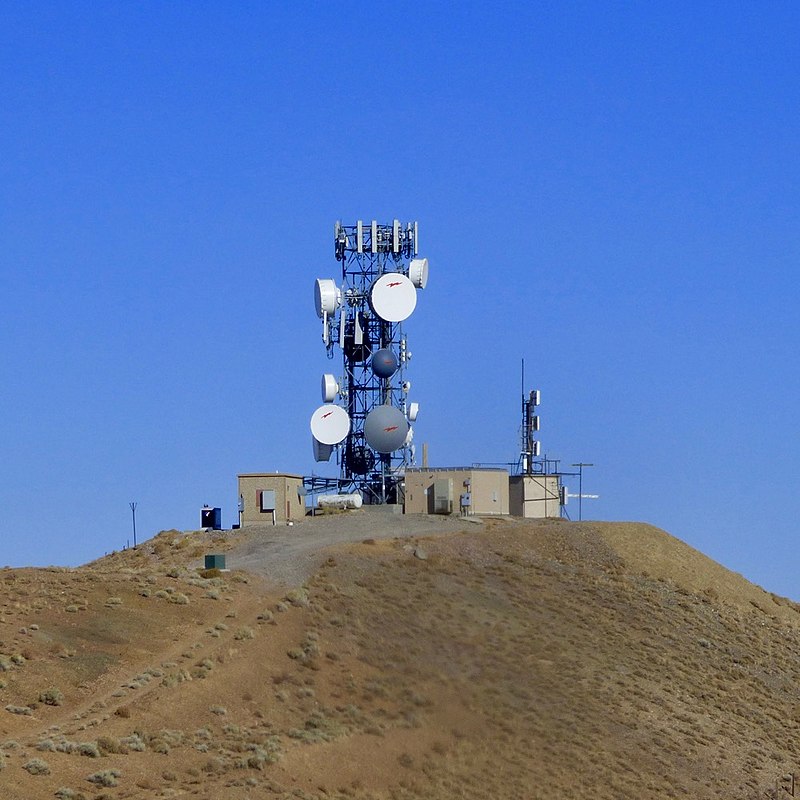
Winnemucca AFS Radio Site Repurposed,
photo by John Stanton 9 Oct 2016 (text by Wikipedia)
(wikipedia.org) (wikimedia.org photo)


Satellite photo of Winnemucca, Nevada (tageo.com)
(tageo.com photo)

Tuesday, 22 January 2019

UFO Case Directory (RADCAT):
“Green & Red Object Circles Jet,
Tracked on Radar (BBU 3969)
Feb. 12, 1956
SW of Goose Bay, Labrador”


(NICAP.org)

The whole UFO case report:
“Dan Wilson:
At 10:55 local time two F-89’s were on a routine training mission when one fighter (with pilot Bowen and radar observer Crawford) had visual and radar contact with an object which rapidly encircled the the F-89D. The color of the object was predominatley green with red and seemed to be flashing. The object was estimated to be 3/4 mile away and was observed for about one minute. The other fighter aircraft also had radar contact. About 15 minutes later an object was observed on radar 38 miles SW of Goose Bay by aircraft controllers. No movement. The fighters were vectored upon the object and had radar contact but faded when the aircraft got within 8 miles. (Berliner; FUFOR Index)”

NICAP.org presents U.S. government (U.S. Air Force) documents that pertain to the UFO case.


Wikipedia article: “CFB Goose Bay”:


Quote from the Wikipedia article:
“Canadian Forces Base Goose Bay (IATA: YYR, ICAO: CYYR), commonly referred to as CFB Goose Bay, is a Canadian Forces Base located in the municipality of Happy Valley-Goose Bay in the province of Newfoundland and Labrador. It is operated as an air force base by the Royal Canadian Air Force (RCAF). Its primary RCAF lodger unit is 5 Wing, commonly referred to as 5 Wing Goose Bay.

Cold War history

1950 – The Rivière-du-Loup Incident

Goose Air Base was the site of the first US nuclear weapons in Canada, when in 1950 the United States Air Force Strategic Air Command stationed 11 model 1561 Fat Man atomic bombs at the base in the summer, and flew them out in December.[12] While returning to Davis–Monthan Air Force Base with one of the bombs on board, a USAF B-50 heavy bomber encountered engine trouble, had to drop, and conventionally detonate, the bomb over the St. Lawrence, contaminating the river with uranium-238.

1954 – Construction of the Strategic Air Command Weapons Storage Area[4]

Construction of Strategic Air Command's Weapons Storage Area at Goose Air Base was officially completed in 1954.[13] The area was surrounded by two fences, topped with barbed wire. It was the highest security area in Goose Air Base and comprised

* One guard house
* One administration building
* Three warehouses (base spares #1, base spares #2, supply warehouse)
* Six guard towers
* One plant group building
* Five earth covered magazines for non-nuclear weapon storage
* Four earth covered magazines for ‘pit’ storage (constructed with vaults and shelving to store pit ‘birdcages’)

Design and layout of the Goose Air Base weapons storage area was identical, with only slight modifications for weather and terrain, to the three Strategic Air Command weapons storage areas in Morocco located at Sidi Slimane Air Base, Ben Guerir Air Base, and Nouasseur Air Base, which were constructed between 1951 and 1952 as overseas operational storage sites. The last nuclear bomb components that were being stored at the Goose Air Base weapons storage area were removed in June 1971.[14]

1958 – Construction of the Air Defence Command ammunition storage area[4]

Construction of the Air Defence Command ammunition storage area at Goose Air Base was completed in 1958.[15] This extension to the Strategic Air Command weapons storage area was built directly beside the previously constructed area, with a separate entrance. The buildings built within the area were:

* Three storage buildings
* One guard house
* One missile assembly building.

The storage was being built to accommodate components of the GAR-11/AIM-26 "Nuclear" Falcon, which is normally stored in pieces, requiring assembly before use.

1976 – Departure of the USAF Strategic Air Command and closure of Goose AB[4]

The former U.S. facilities were re-designated CFB Goose Bay (the second time this facility name has been used). The value of the airfield and facilities built and improved by the USAF since 1953 and transferred to Canada were estimated in excess of $250 million (USD).[citation needed]. By 1976 all Strategic Air Command assets had been stood down, and only USAF logistical and transport support remained.

Hosted deployments of units from:

Royal Air Force (United Kingdom) 1942–2005[1]
United States Air Force 1942–1976”

Wikipedia article: “Northrop F-89 Scorpion”:


Quote from the Wikipedia article:
“The Northrop F-89 Scorpion was an American all-weather interceptor built during the 1950s, the first jet-powered aircraft designed for that role from the outset to enter service.[3] Though its straight wings limited its performance, it was among the first United States Air Force (USAF) jet fighters equipped with guided missiles and notably the first combat aircraft armed with air-to-air nuclear weapons (the unguided Genie rocket).”

Related posts:


realtvufos.blogspot.com/search?q=1956


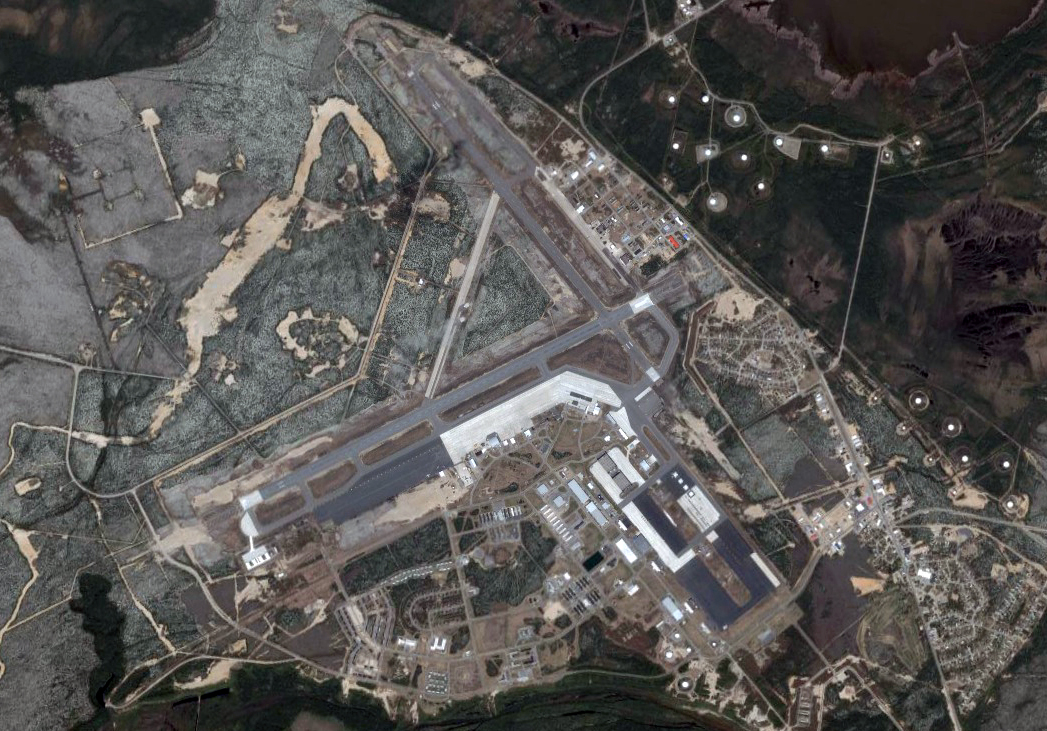
Canadian Forces Base Goose Bay, Labrador, Canada
(wikimedia.org) (wikimedia.org photo)


U.S. Air Force Northrop F-89D-45-NO Scorpion interceptors of the 59th Fighter Interceptor Squadrons, Goose Bay AB, Labrador (Canada), in the 1950s. 52-1959 in foreground, now in storage at Edwards AFB, California (text by Wikipedia) (wikimedia.org) (wikimedia.org photo)


Satellite photo of Goose Bay, Canada (tageo.com)
(tageo.com photo)